
Overview
The 5E Model is an inquiry-based instructional framework developed by the Biological Sciences Curriculum Study (BSCS) under Dr. Roger Bybee in the late 1980s.
Rooted in constructivist learning theory — the idea that students build knowledge through experience and reflection — it was originally designed for science education but is now widely used across all subjects and grade levels.
It consists of five sequential phases: Engage, Explore, Explain, Elaborate, and Evaluate.
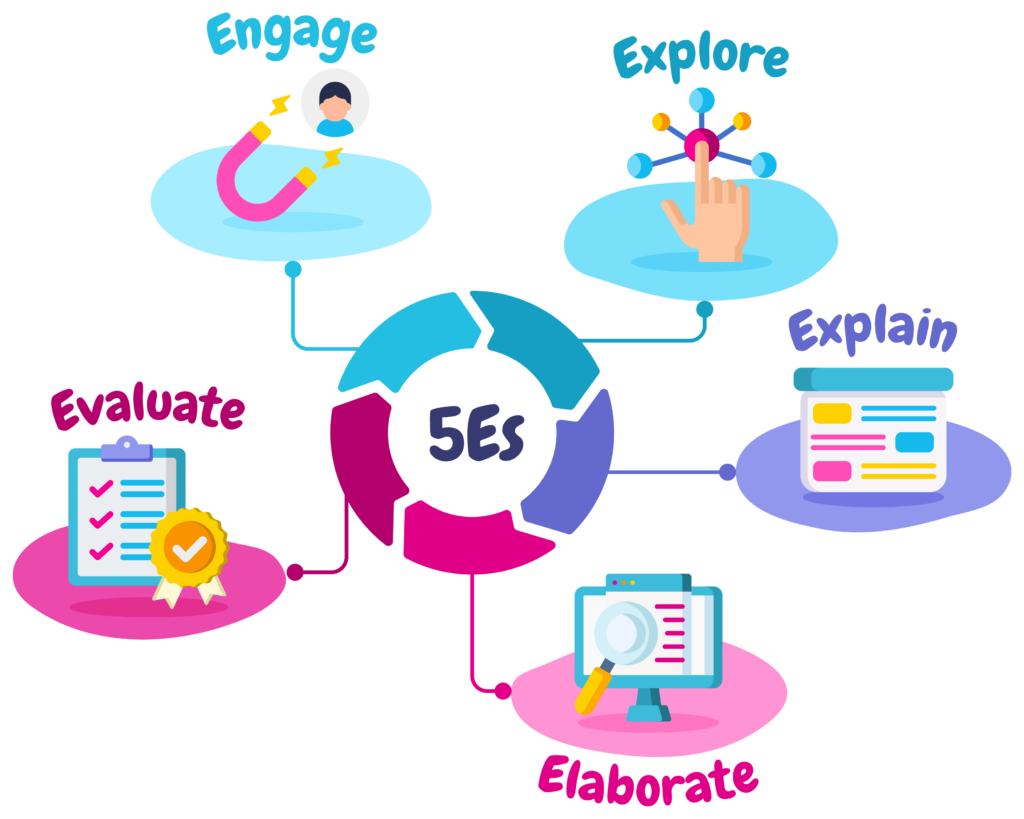
Phase 1: Engage
Activates students’ prior knowledge and sparks curiosity about the new topic. The teacher introduces the lesson through thought-provoking questions or challenges. Students ask questions, share observations, and express what they already know.
Phase 2: Explore
Students investigate and experiment with new ideas through hands-on activities. The teacher acts as a facilitator — guiding without giving away answers. Students test hypotheses, collect data, collaborate, and develop initial explanations.
Phase 3: Explain
Students present their findings and initial models from the Explore phase. The teacher then formally introduces key concepts, vocabulary, and definitions. Students refine their understanding based on new information and peer feedback.
Phase 4: Elaborate
Students apply what they’ve learned to new or related situations. This helps deepen understanding, address misconceptions, and transfer knowledge to different contexts. The teacher encourages use of scientific language and probing questions like “What do you already know?” and “Why do you think that?”
Phase 5: Evaluate
Students reflect on and self-assess their own learning progress. Both informal (ongoing observation) and formal assessments (quizzes, projects) are used. The teacher uses open-ended questions like “What evidence supports your explanation?” to gauge understanding.
Key Takeaways
-
The model is student-centered — the teacher shifts from lecturer to facilitator throughout the process.
-
Most effective when used over a unit of two to three weeks, not a single lesson.
-
Promotes deeper understanding by allowing students to construct knowledge rather than passively receive it.
-
Applicable across all content areas and grade levels, not just science.
Author: Dr. Serhat Kurt
Source: https://educationaltechnology.net/5e-instructional-design-model/
Published: November 20, 2024
Read time: 7 minutes
